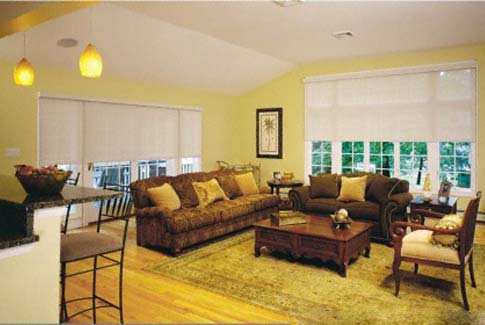
Roller shades have been utilized for window coverings throughout the ages. Without a doubt, one of the most effective treatments for room darkening, screen fabrics also provide outstanding performance when it comes to privacy and the reduction of heat and glare from the sun. This can all be achieved without compromising the amount of natural light in the space or the view of the world outside. Three basic factors, (density, weave, and color), determine the performance of the fabrics and invariably what fabric is best suited for your application. Hardware systems include spring tension with options for speed controls or adjustable limit stops, chain operators, crank mechanisms, and motorized systems with programmable controls to facilitate any application.
Ideal for all elevations in a home where the view outside is far more important than the issue of privacy
Further information
Density:
- Fabrics are manufactured using a range of visibility factors, (or fabric density), from 1 to 25% open. This measurement actually represents the amount of fabric absent from a 100% blackout shade cloth. The standard density for east, south, and west elevations is 3 to 5% open where a north facing window can be properly treated by using a 10 to 14% open shade cloth. This standard can be varied depending on the required amount of heat, glare, and light control or view desired.
Weave:
- Stock fabric programs - Screen fabrics are
mainly manufactured into 2 types of fabric weaves
1) Basket weaves - where the horizontal yarn (weft) is woven through the vertical yarn (warp) at a ratio of one to one.
2) Finer weaves - where the warps and wefts are woven in a specific pattern to give a staggered repeat or diagonal stripe. These weaves can assist in reducing glare when looking straight on, but allow sunlight into the room and increases the view outside when looking from an angle.
- Specialty fabrics - Larger manufacturers have the ability to weave a variety of specialty fabric patterns and colors in the full range of densities. Some of these alternative fabrics include random weaves or designs where they are woven with a neutral or lighter back compared to the front face of the fabric.
Color:
- Fabrics are primarily manufactured in a palette consisting of earth tones with a range from whites and off whites to browns and blacks. A dark colored fabric is best suited to optimize the image or view during the day due to the contrast of light outside versus the fabric inside. A darker fabric is also better for light control because it restricts the amount of glare that enters the room from the outside. It does however have a down side with respect to the heat reduction as a darker fabric will attract more heat to the glazing. A light colored fabric is therefore best suited for heat reduction, but increases the glare and amount of light entering the room which greatly reduces the clarity of the image outside. This is attributed to the lack of contrast of the image behind versus the fabric inside.
Given the information above, it is recommended that a mid tone color is selected to give a satisfactory level of all properties. There is however one other alternative. A select few of the fabric mills are now manufacturing screen fabrics in such a way that the front, (or room side), of the fabric is darker and the back, (or window side), is lighter. This is slightly more expensive, but provides all the features of the darker fabric from the inside combined with a reduction of heat from the lighter color on the outside. The added bonus is an increase in privacy during both day and nighttime hours from the outside looking in. This is again attributed to the lack of contrast of the image, (now inside), versus the light color of the fabric on the outside.
Hardware types:
- Spring tensioned shades - Operated by hand using weight bars or brass pull rings. Additional features include speed controls to eliminate over rotation during lift and limit controls to easily align multiple banks of shades to specific heights or stop points during the lifting process.
- Chain operated shades - Plastic or metal
bead chain pulled through an enclosed gear system
to raise and lower shade panels. Additional features
include
1) spring tensioned inserts that operate in conjunction with the clutch mechanism to assist in raising large shades in the 100 to 200 square foot range
2) banded shades where several chain shades are banded together on one clutch to reduce the amount of chain locations in the event that there are numerous shades in one room.
- Crank operated shades - Often used where shade panels exceed the 100 square foot range, these systems can also be effective in situations where the windows are high or difficult to reach as well as where security of the shades is required. The crank systems allow the flexibility of having the operators manufactured with the cranks removable which is ideal in areas of health care or where controlled operation of the shades is a major consideration.
- Motorized shades - Ideal for larger windows, but surprisingly low in cost when considering solutions for spaces with hard to reach windows or where multiple shade panels are required. Can be used for lifting shades or banded panels where the overall square footage is in the 300 square foot range. Control options include wall switches, infrared and radio remotes, timers, sun and heat sensors, as well as a full line of AV or computer interfacings for boardroom or home theater control systems.